NextAds

Envision Next-Generation Personalized Video Advertising

1 University of Science and Technology of China, Hefei, China 2 National University of Singapore, Singapore
Experimental Details

Implementation

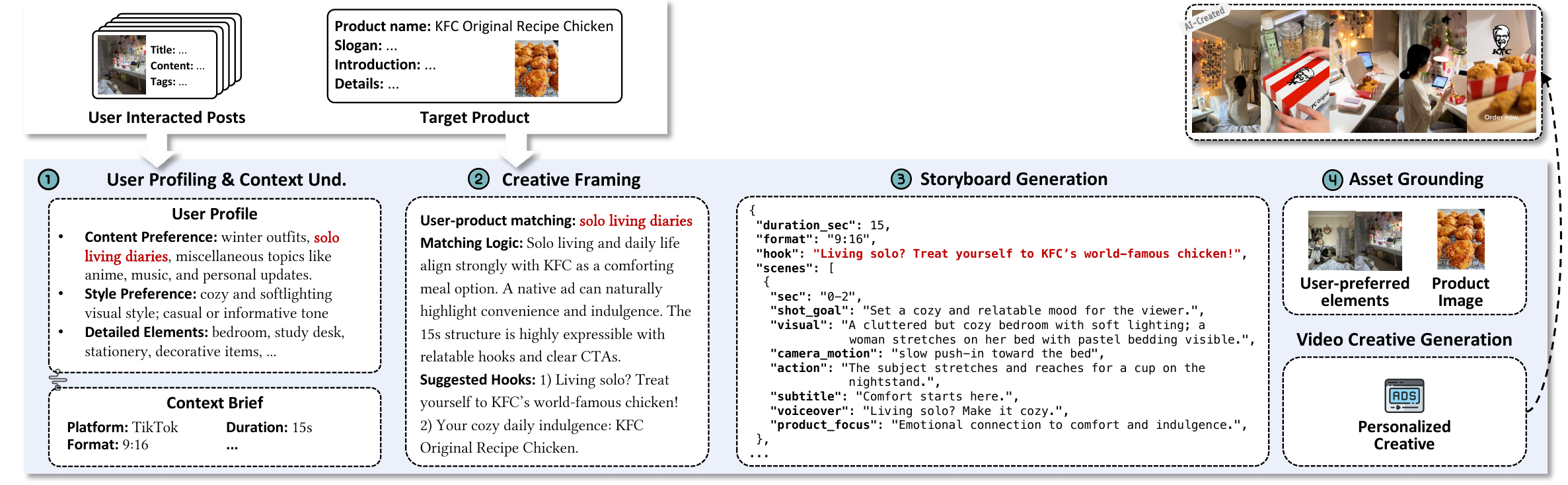
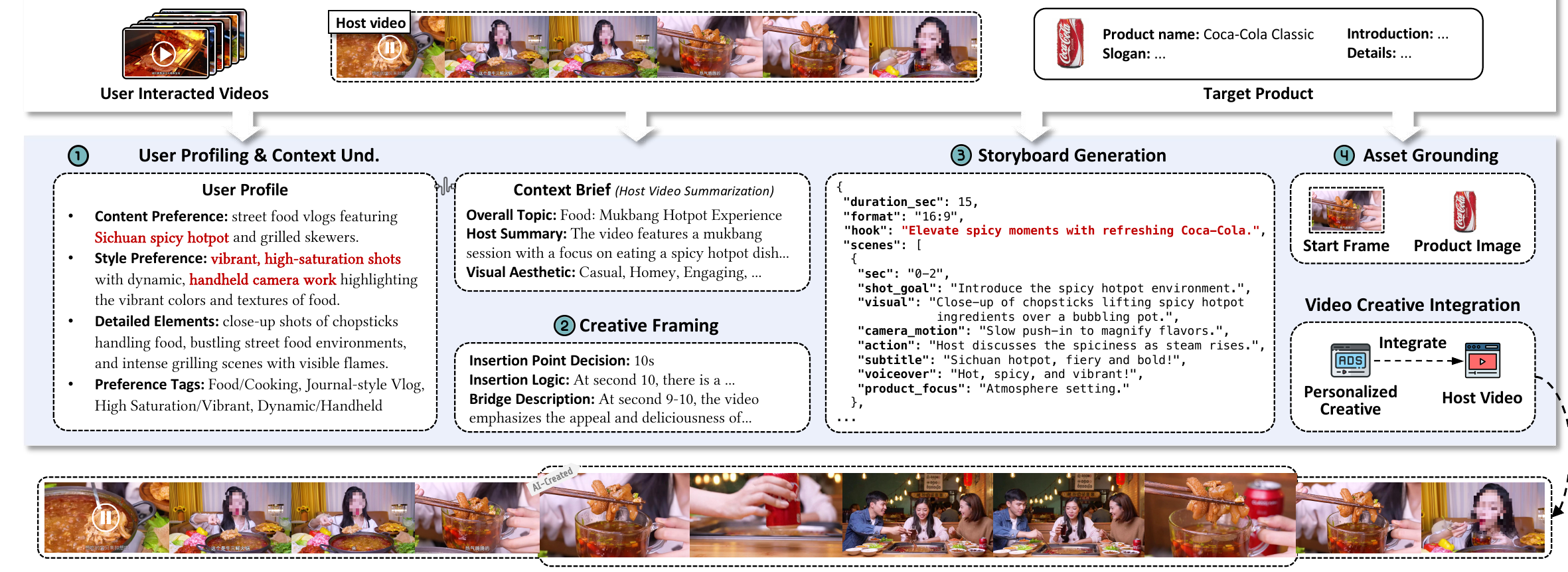
We implement Director and Producer using both open-source and closed-source GenAI: 1) NextAds (open-source): Qwen3-VL as Director and Wan2.2 as Producer; and 2) NextAds (closed-source): GPT-4o as Director and Sora2 as Producer. For comparison, we also include GenericAd (closed-source), where Director conditions only on the target product and serving context. It uses no user-specific data in either task; for PCI, it also excludes the host video.

Pipelines

Overview of the PCG pipeline
Figure 5: Overview of the PCG pipeline.
Overview of the PCI pipeline
Figure 7: Overview of the PCI pipeline.

Overall Performance

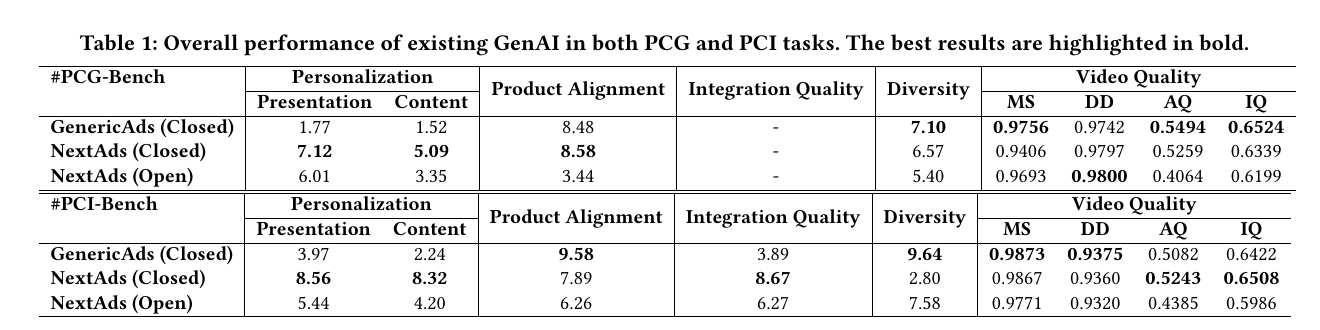
Overall performance of existing GenAI in both PCG and PCI tasks
Table 1: Overall performance of existing GenAI in both PCG and PCI tasks. The best results are highlighted in bold.

Personalized Creative Generation

  • Compared to GenericAds, NextAds significantly improves personalization while preserving comparable product alignment and video quality, highlighting the potential of current GenAI to leverage user-specific signals for the PCG task. However, the slight drop in diversity suggests a trade-off between personalization and diversity; developing methods that improve both simultaneously remains a promising direction for future research.
  • Open-source NextAds achieves video quality comparable to its closed-source counterpart. However, its inferior personalization and product alignment suggest that current open-source models still struggle with complex conditioning, particularly when guided by detailed storyboard scripts and reference visual collages. Nevertheless, we believe this issue will be substantially alleviated with continued progress in open-source models.
Personalized Creative Integration

  • Compared to GenericAds, NextAds achieves substantial gains in personalization while maintaining comparable video quality. Most importantly, the integration decision stage enables more seamless creative integration into the host video. However, product alignment decreases under this more constrained setting, as the model must jointly satisfy host-video continuity and strict grounding while incorporating user-specific preferences. Moreover, the requirement of seamless integration narrows the space of feasible generations and thus reduces diversity, revealing a trade-off between integration quality and diversity. Together, these observations highlight an important open challenge: how to preserve strong user preference modeling while maintaining product consistency, while also achieving high-quality integration without sacrificing diversity, capabilities that are likely crucial for advancing personalized creative integration systems.
  • Closed-source models typically exhibit stronger visual understanding and generation capabilities, leading to more accurate user modeling and higher-quality video creatives. For example, the closed-source NextAds nearly doubles the performance of the open-source one in personalization. Interestingly, the open-source model attains a relatively higher diversity score; however, this apparent advantage likely reflects weaker controllability and instruction following, i.e., it does not strictly adhere to the conditioning signals such as storyboard constraints and integration requirements, thereby producing more varied but less aligned outputs. In contrast, the closed-source model follows longer and more complex scripts more faithfully, and the resulting stricter conditioning can narrow the feasible generation space and exacerbate diversity collapse.

Case Studies

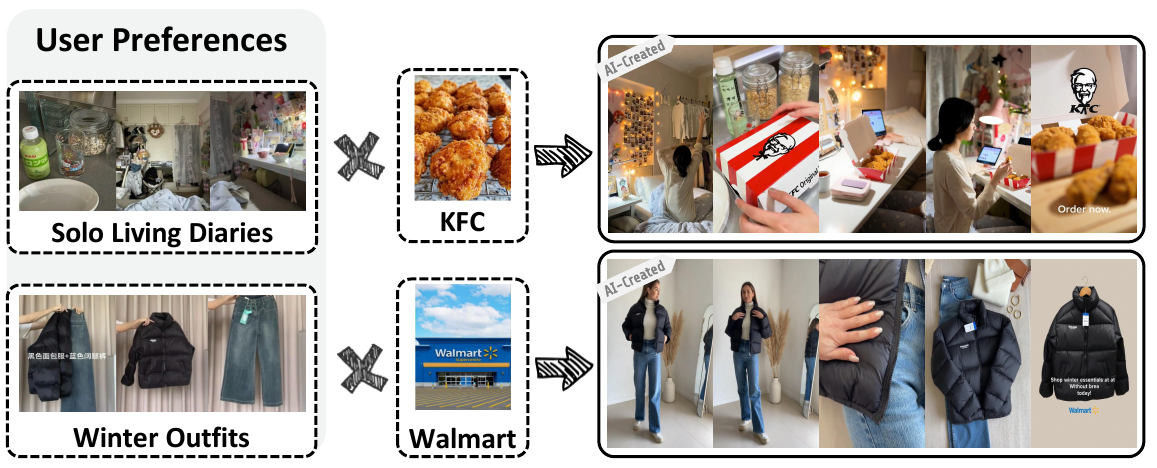
Examples generated by NextAds on PCG-Bench
Figure 6: Examples generated by NextAds on PCG-Bench.

We present examples generated by closed-source NextAds in Figure 6. Based on user interaction history, the model accurately infers two dominant preferences (i.e., Winter Outfits and Solo Living Diaries) with a stronger inclination toward the former. For Walmart, the model identifies high semantic compatibility between the user’s interest in Winter Outfits and Walmart’s apparel-related offerings, and thus generates a hook centered on “Winter fashion essentials under $50” to capture attention. In contrast, for KFC, the model pivots to Solo Living Diaries, which better aligns with KFC’s themes of comfort and convenience, and constructs a storyline around “Your cozy daily indulgence”. Overall, this adaptive user-product matching prioritizes user–product compatibility over naive top-interest matching, improving relevance while reducing the risk of semantic mismatch.

Open full-resolution figure ↗
Examples generated by NextAds on PCI-Bench
Figure 8: Examples generated by NextAds on PCI-Bench.

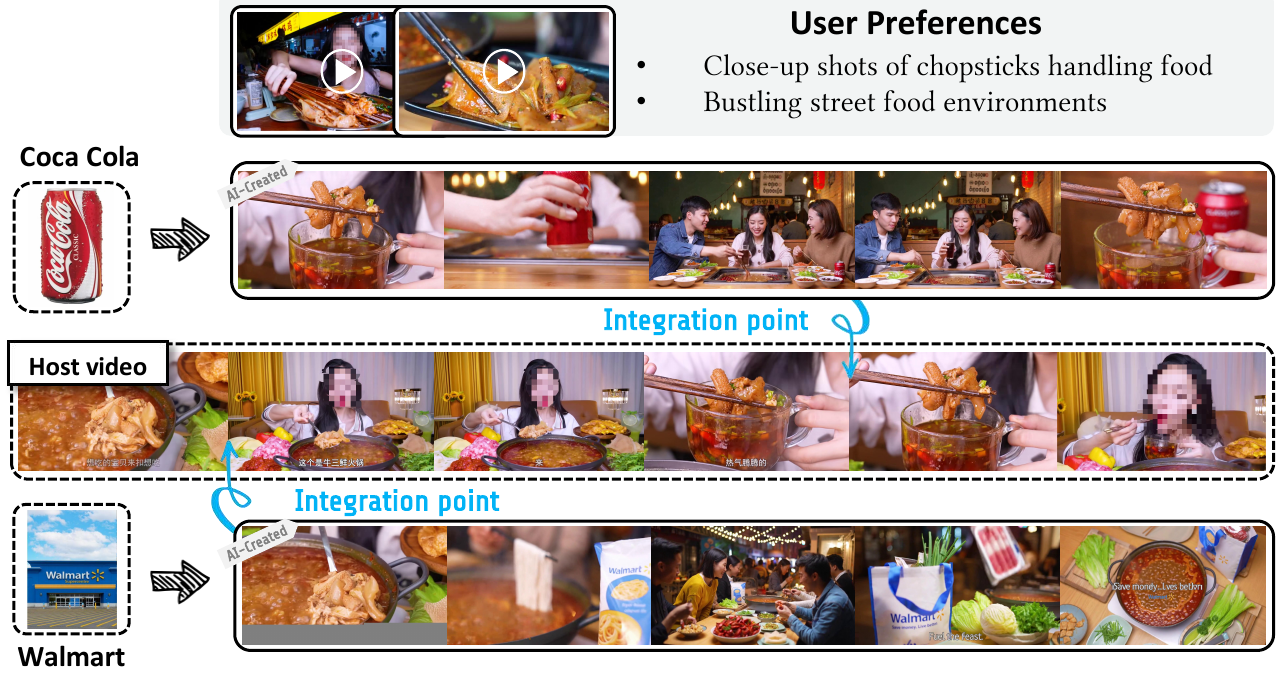
We present examples generated by the closed-source NextAds in Figure 8. Based on user interaction history, the model accurately infers user preference for Sichuan cuisine and lively, crowd-rich scenes, and incorporates these cues into the generated creatives. For Coca-Cola, the creative transitions smoothly from the host preparing to taste spicy food to picking up a bottle of Coca-Cola, positioning it as a complementary beverage to Sichuan hotpot. This preserves narrative continuity while grounding the product in the surrounding scene context. For Walmart, the host video segment showcasing hotpot ingredients naturally shifts to a Walmart supermarket scenario, where these ingredients are framed as being sourced from Walmart, enabling contextually coherent integration. Overall, these cases demonstrate that NextAds can effectively capture user preferences to generate personalized creatives for the target product, and seamlessly integrate the resulting ad segments into the host video.

Open full-resolution figure ↗

Discussion

Failure Analysis

Spurious conditioning

A key challenge arises when personalization is driven by high-level semantic or conceptual user preferences (e.g., lifestyle, narrative vibe, or perceived quality), which do not necessarily require specific visual cues to be expressed. However, current generative models can exhibit spurious conditioning: they realize these high-level preference signals by introducing unnecessary visual cues that act as noise and may even conflict with the grounded target product images. A representative case is brand-centric preferences. For example, when targeting an Adidas product to a user who frequently engages with Nike content, the model may inadvertently inject Nike-associated design patterns (e.g., Swoosh-like curves) into the rendered Adidas shoe, leading to brand-confusion artifacts. This phenomenon places higher demands on Director for user modeling that avoids unnecessary visual instantiation, as well as stricter asset grounding to preserve product alignment.

Forced personalization under low compatibility

Personalization is beneficial only when user preferences can be semantically and visually reconciled with the target product. In low-compatibility settings, forcing a match, even the “least-bad” one, often yields incoherent creatives and visual dissonance, ultimately hurting user experience. For instance, pairing soft pastel style with Gillette Razor can result in an industrial razor awkwardly placed in a soft, dreamy environment. This motivates a practical fallback strategy: when user–product compatibility falls below a threshold, the system should revert to a generic (non-personalized) creative rather than forcing personalization.

Key Insights In Pipeline Design

Decoupling planning from execution

NextAds explicitly separates Director (creative planning) from Producer (video synthesis), committing to a structured plan before pixel-level generation to better preserve narrative coherence and overall quality. Crucially, exposing an interpretable intermediate plan further enables automated and human verification/intervention (e.g., compliance checks and integration-point validation), improves controllability via direct plan revision, and facilitates error attribution by isolating failures in planning versus execution. This modular design also allows Director and Producer to be upgraded independently without re-engineering the entire system.

Multi-source visual grounding for faithful generation

Text-only prompting often fails to reliably preserve visual details, leading to product drift, misaligned personalization, and contextual mismatch with the host video. We therefore ground generation with three complementary visual references: 1) target product images to lock key product attributes, 2) user-preferred visual elements to anchor personalization, and 3) the integration start frame for the PCI task to match the host context and support seamless transitions. Together, these references act as hard constraints that improve product faithfulness, preference alignment, and integration coherence.

Citation

arXiv:2603.02137 · DOI: 10.48550/arXiv.2603.02137Paper ↗
@article{xu2026nextads,
  title={Envision Next-Generation Personalized Video Advertising},
  author={Xu, Yiyan and Xia, Ruoxuan and Zheng, Wuqiang and Zhu, Fengbin and Wang, Wenjie and Feng, Fuli},
  journal={arXiv preprint arXiv:2603.02137},
  year={2026},
  doi={10.48550/arXiv.2603.02137}
}